
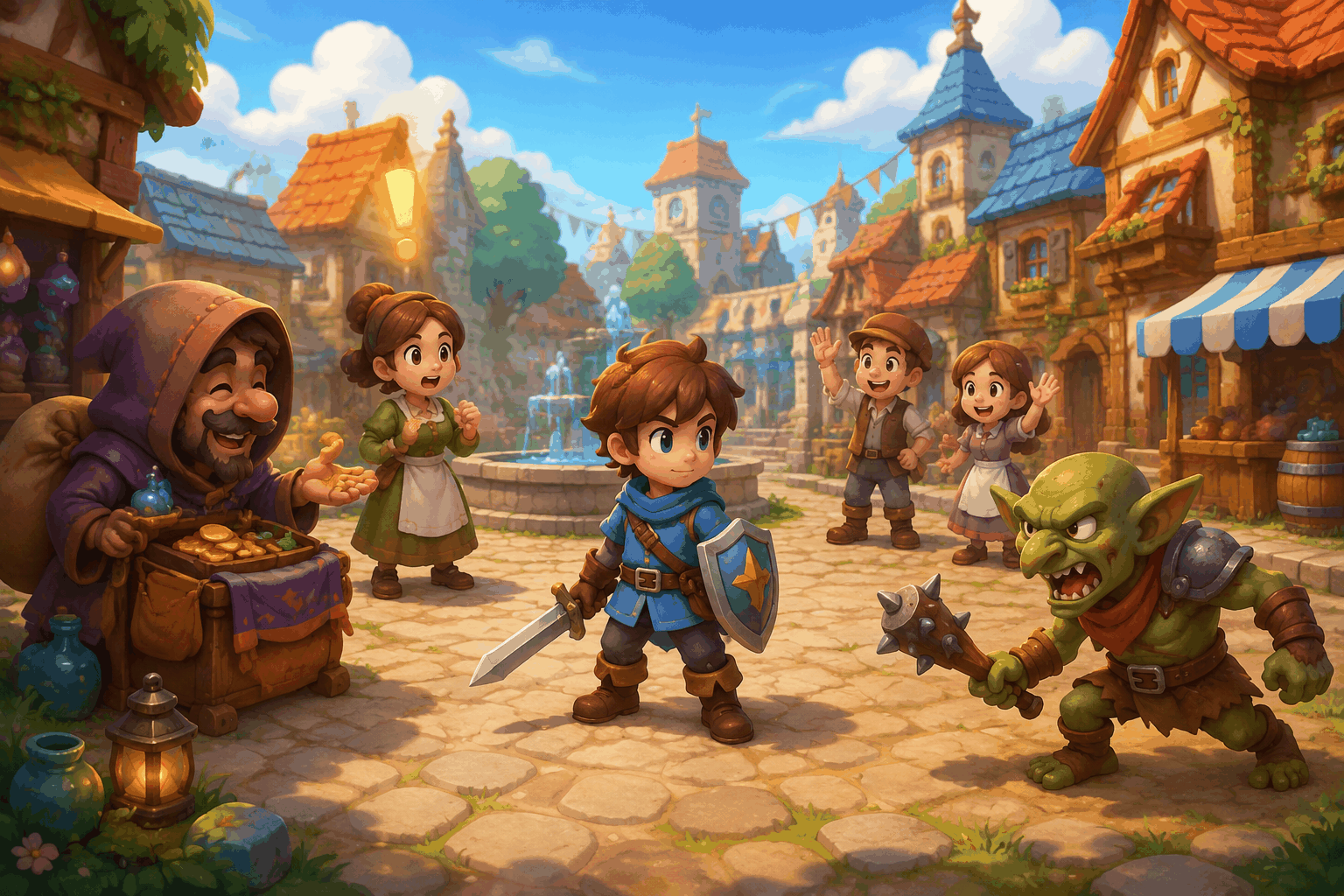
If you've played almost any video game, you've met hundreds of NPCs without ever calling them that. The shopkeeper who sells you potions. The villager who keeps repeating that the king's crown was stolen. The rival trying to cut you off on the track. The goombas. All of them are NPCs, and once the word is in your head, you start seeing it everywhere — inside games, and lately, all over the internet as an insult.
This is a plain-English guide to what an NPC is, where the name came from, the main types you'll run into, and how AI is quietly changing what these characters can do. If you'd rather see characters in action first, the showcase library on makegame has plenty of AI-made games to poke around in — but let's cover the basics first.
What does NPC mean?
NPC stands for non-player character. The short version: any character in a game that a human player does not directly control. Instead the game itself — its code, its scripts, or an AI system — decides what that character does, says, and how it reacts.
The term exists to draw a line against the player character (PC), the avatar you move around yourself. In a tabletop role-playing game, you roll the dice for your own PC while the game master voices and controls every NPC. Video games just automate the game master's job.
A couple of distinctions tend to trip people up:
- An NPC is not the same as a "bot." A bot usually means an AI playing as a player — filling an empty seat in a multiplayer shooter, for instance. It's standing in for a human, not playing a role inside the fiction.
- Enemies and NPCs overlap but aren't identical. A goomba is a non-player character by the strict definition, yet most gamers reserve "NPC" for characters you interact with — trade with, talk to, get quests from — rather than the ones you simply stomp or shoot.
- Background characters milling around a town are NPCs too, even when they have nothing useful to say. They're there for atmosphere.
That middle point — interact versus fight — is the line most people use intuitively, and it's the working definition we'll lean on through the rest of this guide.
Where the term NPC comes from
"Non-player character" is older than video games. It comes from tabletop role-playing games, most famously Dungeons & Dragons, which launched in 1974. Sitting around a table, one person is the Dungeon Master: they run the world and play every character the players bump into — the innkeeper, the villain, the cloaked stranger in the corner. Those DM-controlled characters were the original NPCs, and the label carried straight over into early computer role-playing games.
Once games moved onto screens, those characters had to be automated, and early versions were barely characters at all. Many just stood in one spot and fired off a single line of text when you pressed a button — "Welcome to the village!" or, in the case of a certain plumber's adventures, "The princess is in another castle." That famous line is essentially an NPC doing its one job.
Through the 1980s and 90s, role-playing games pushed NPCs further. Series like Final Fantasy, Dragon Quest, and The Legend of Zelda filled their worlds with people who handed out quests, dropped hints, and gave towns a sense of life. Almost all of them still ran on dialogue trees: pick a response from a menu, get a canned reply, pick another, get another canned reply. The illusion of conversation, assembled from branching scripts that a writer had mapped out in advance.
The next real leap was schedules and routines. Ultima VII, released in 1992, gave its NPCs daily lives — a blacksmith who opens his shop in the morning and wanders to the tavern at night, whether you were watching or not. Bethesda's The Elder Scrolls series later pushed this further with its Radiant AI system, where characters supposedly had needs, jobs, and relationships that shaped their behavior. The results were sometimes impressive and sometimes ridiculous — there are well-worn stories of NPCs turning on each other over a stolen loaf of bread — but the ambition was the point: make the world feel like it keeps running when you aren't looking.
Types of NPCs you'll meet
Not every NPC does the same job, and most fall into a handful of roles.
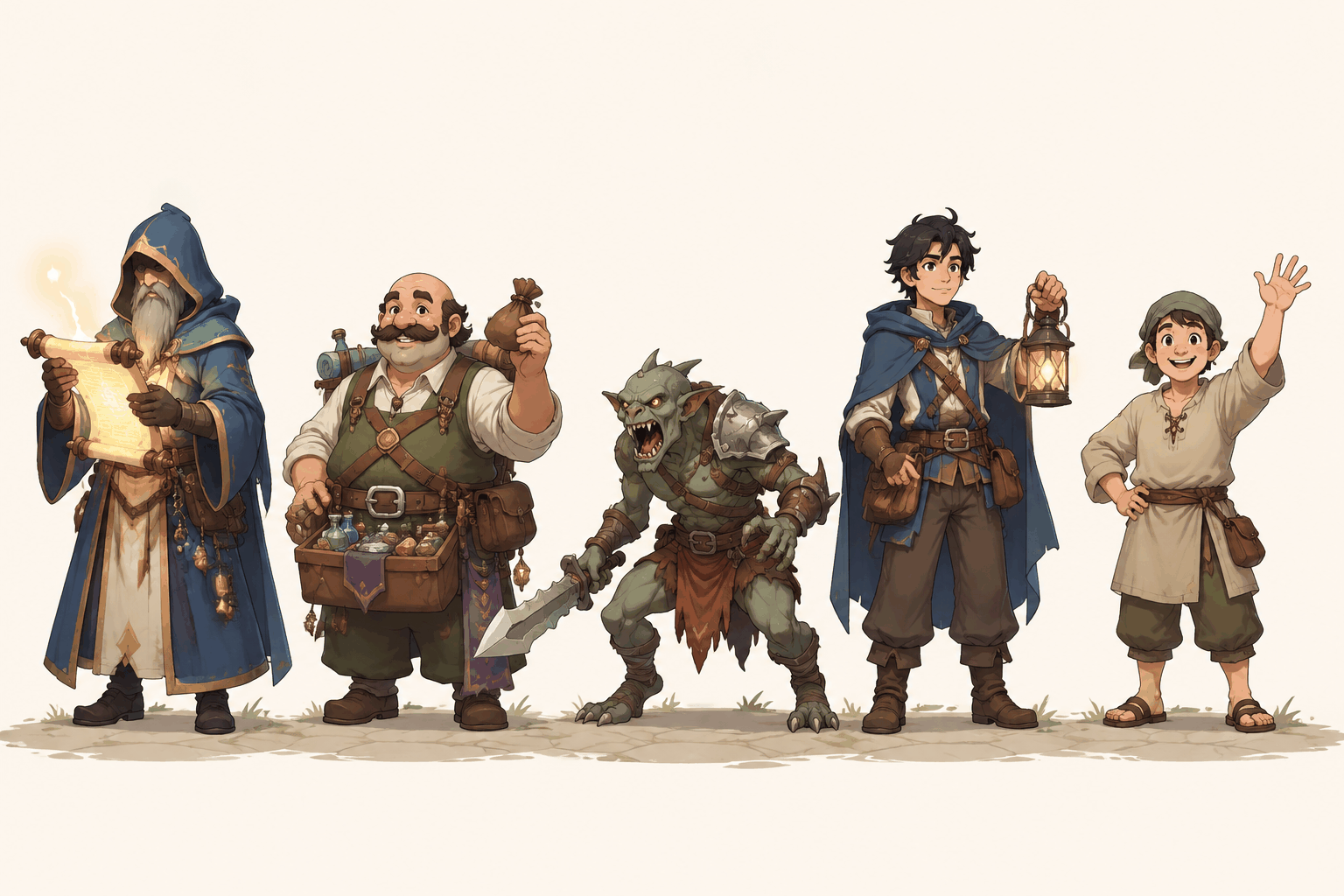
Quest givers are the ones who hand you an objective — "clear out the cellar," "find my lost necklace," "save the kingdom." They're usually marked with a floating icon over their head so you can spot them across a crowded town square.
Merchants and shopkeepers exist to trade. They buy your loot, sell you gear and consumables, and tend to be the most-visited characters in any game.
Enemies fight back. As mentioned, players often call these "enemies" or "mobs" rather than NPCs, but under the strict definition they count.
Companions and party members are NPCs who join you and fight or puzzle alongside you — the party in a Final Fantasy, the follower trailing you through Skyrim. Not you, but on your side.
Background and ambient characters are the crowds that make a city feel populated. No real function, usually no name, one or two generic lines. Delete them and the world suddenly feels hollow.
The type tells you a lot about how much craft went into a character. A quest giver earns a full dialogue tree; an ambient villager gets a shrug and a grunt. Both are NPCs, but the budgets behind them are wildly different.
How AI is changing NPCs
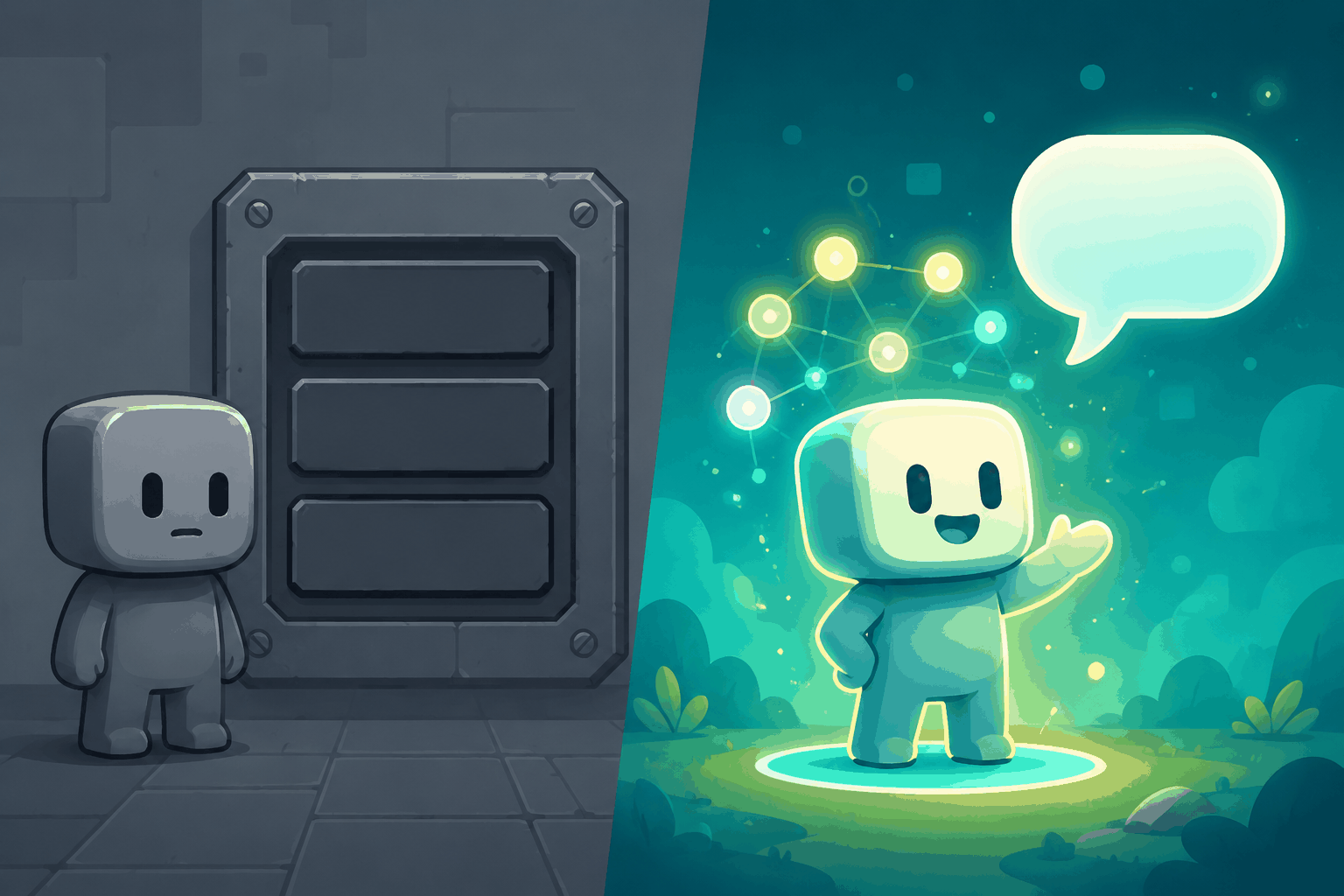
For roughly forty years, an NPC was a closed script. You talked to the same blacksmith in 1995 and he'd say the identical line in 2005. Dialogue trees can be enormous, branching, even clever, but they're still closed loops: every word was written ahead of time by a human, and once you've walked the branches you've seen everything the character has to offer.
Large language models cracked that open. An NPC can now generate its own replies. Instead of choosing from three menu options, you can type or speak almost anything and get an answer the writers never planned for. Startups like Inworld AI and Convai, plus a wave of hobbyist mods that wire ChatGPT into Skyrim, are all chasing the same idea: characters with a personality, a backstory, and the ability to hold a real conversation.
The promise is genuine. An AI-driven NPC can remember what you told it, react to choices you made hours ago, and never run out of things to say. For role-playing games and social sims, that's a real step up from reading the same signpost text for the hundredth time.
The catch is just as real. Language models hallucinate, so an NPC might confidently hand you a quest detail that doesn't exist, or forget a key fact two minutes after learning it. Keeping a character consistent across a long session is genuinely hard. And producing every line of dialogue on the fly is expensive, which is why fully AI-driven NPCs are still mostly experiments and mods rather than the default in shipped games. The honest framing: AI has changed what's possible, but most NPCs you meet today are still scripted, and that's fine — scripts are reliable and cheap.
How to make an NPC with AI
Here's where it gets hands-on. If you want to build your own NPC — for a game, a prototype, or just to mess around — AI tools have dropped the barrier a long way, and you don't need a traditional game engine to begin.
The fastest path is an AI game generator like the one on makegame. You describe a game in plain language and the characters inside it — the player, the enemies, any friendly faces — get generated along with everything else. The trick is being specific about the people in your prompt:
- Give the character a role (a wandering merchant, a grumpy gate guard, a lost child).
- Give them a personality and a voice (terse and suspicious, cheerful and long-winded).
- Give them something to do in the game (sells potions, blocks a bridge until you solve a riddle).
One honest note about scope. makegame's games lean toward quick, single-mechanic experiences rather than sprawling RPGs with deep conversation systems, so the NPCs you get there are lightweight — enemies, companions, and simple characters rather than fully voiced conversational partners. You can feel out the range in the showcase library; a game like Draw to Save Dog is built around a character you protect, and Gold Miner drops you into the boots of a prospector clawing treasure out of the ground.
If what you actually want is a talking NPC — one that genuinely responds to you — that's the other half of the workflow. You'd use a large language model to write the character's lines, lock down their personality and memory in a system prompt, and let the model generate replies on the fly. Bolt that generated dialogue onto a game you built in a generator like makegame, and you've got the bones of a custom NPC without writing code or hiring a writer.
So the practical split is this: scripts still carry most NPC behavior because they're dependable, and AI is where the surprising, "I can't believe it just said that" moments live. Use both.
Frequently asked questions
What does NPC stand for?
NPC stands for "non-player character." It means any character in a game controlled by the game itself — its code, scripts, or AI — rather than by a human player. Shopkeepers, quest givers, enemies, and background townsfolk all count as NPCs.
Are NPCs real people?
No. An NPC is run by the game, not by a person sitting at a keyboard. The one exception is online games, where another human's character is simply another player, not an NPC. If a character acts on its own, following rules or scripts, it's an NPC.
What does NPC mean in slang?
Online, "NPC" became slang for a person who seems to move through life on autopilot — echoing popular opinions, following the crowd, with no visible independent thought. It took off as an internet insult in the late 2010s and gets thrown around across the political spectrum. The idea comes straight from gaming: a character that repeats the same pre-written lines over and over.
Can AI make NPCs that actually talk to you?
Yes, within limits. Large language models can power NPCs that generate their own dialogue and respond to what you say instead of sticking to a written script. They can feel surprisingly alive, but they can also be inconsistent, forgetful, and expensive to run, so most released games still rely on scripted dialogue for reliability.
Make a game with your own characters
That's the full picture: NPCs are any character the game controls, they've grown from single-line signposts into scheduled, living townsfolk, and AI is now letting a few of them actually talk back. The neat part is that you don't have to just read about it.
Start with the AI game generator → — describe a world, drop in a character or two, and play what you imagined, right in your browser.