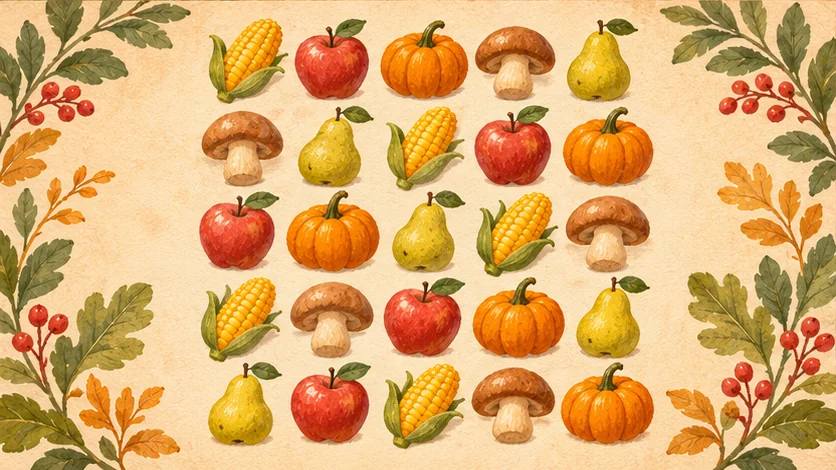
About Harvest Match
Harvest Match is a Thanksgiving match-three template with an eight-by-eight board of pumpkins, corn, apples, pears, and acorns. Gather ingredients and reach a score target within 20 moves. Adjacent swaps create lines of three or more, while falling tiles can trigger cascades.
Build your own puzzle from this MakeGame design. Cream-paper artwork and gentle animation suit the harvest theme, while distinct tile shapes keep decisions readable. The proposed rules require valid moves or automatic reshuffling, so an unlucky board should not strand a player.
How to play
- Read the ingredient goal and score target before making a swap. Scan the whole board for useful lines, paying attention to the limited move count rather than taking the first visible match.
- Choose an adjacent pair that creates at least three matching tiles. After they clear, watch how the empty spaces change nearby rows and columns; a cascade may solve part of your next objective.
- Reassess after every settled board. Use the remaining moves to close the biggest gap in your goal, then review the result before restarting with a different approach to early swaps.
Controls
- For touch input, select a tile and its adjacent neighbor with a short swipe or a clearly explained tap sequence. Diagonal exchanges do not belong to the starter rules.
- For mouse input, use the same adjacent-swap pattern and highlight the selected tile. Let the board finish resolving its cascades before accepting the next move.
A few helpful tips
- Look near the lower rows for swaps that move more tiles above them. Those changes can open new matches, but check whether they also help the ingredients you actually need.
- Avoid spending several moves chasing a pattern that is no longer available. Cascades reshape the board, so a plan should be updated after each resolution.
- When creating your version, make objectives and remaining moves visible together. A pretty board is less useful if players have to remember which ingredient still matters.
Create your own Harvest Match game
Keep the part you love and change the character, setting, or challenge. Add one of these twists to the starter idea below.
- Build a recipe collection where each level asks for different proportions of apples, corn, and pumpkins. Change the objective before adding more tile varieties.
- Try a relaxed edition with no move limit and a small ingredient checklist. Keep the feedback clear so completion still feels like finishing a recipe.
- Create a compact board for younger players with fewer produce types and a lower target. Test that the smaller layout still produces valid adjacent swaps.
Your game starter
Create a Thanksgiving match-three puzzle with an 8-by-8 board of illustrated pumpkins, corn, apples, pears, and acorns. Let players swap adjacent tiles to match at least three, trigger cascading matches, and collect ingredients within 20 moves. Always provide a valid move or reshuffle automatically. Add a score target, gentle animations, restart, and touch-friendly controls on a cream-paper background.
Create from this templateOpens the MakeGame creator, where you can edit the idea. Generation uses your account and available credits.
Good to know
Does this template include special bombs or striped tiles?
The starter prompt specifies ordinary matches, cascading clears, ingredients, and a score goal. Special tiles are a possible addition for your own version, but they need separate rules and visual explanations so their effects remain understandable.
What should happen when no matching move is possible?
The design calls for an automatic reshuffle or another valid-move guarantee. A reshuffle should preserve the player’s progress and clearly show the new arrangement. It should not quietly consume a move for a situation the player could not solve.